Showing posts with label overseas travel. Show all posts

Wednesday, June 26

Bergen

It's been a busy few months with a few trips for work, holidays and weekends away keeping me on the move pretty much constantly - or so it feels!

Latest trip was to Bergen, Norway, where I was treated to a much bluer sky than London, and even some warm sunshine. The Hanseatic Wharf on the harbour side in the middle of the city proved a beautiful and fascinating place, with its 18th century rebuilt wooden houses, many of them a bit lopsided and all of them looking pretty ramshackle. 


Part of the conference social programme included a walking tour, during which I learned all about Bergen's historic role in the stockfish trade and the fact that the city fell under control of the Hanseatic League after most of its indigenous population was wiped out by the Bubonic Plague that arrived on a boat from England. Luckily the Norwegians don't seem to bear a grudge about that, they are too busy feeling aggrieved about various historic wrongs visited on them by their neighbours in Denmark.


As well as the wooden houses, there's quite a bit of 20th century architecture in the city, including this wonderful department store which was designed by architect Per Grieg and built in 1938 as the city's first shopping centre. The statue on top of the tower is apparently Mercury, Roman god for trade, commerce and profit.


Close by the Sundt store is this rather dramatic Sailor's Monument which was completed in 1950 and is surrounded by statues representing sailors through the ages, topped with four panels showing different seafaring scenes - including whaling, naturally. You can't get away from whole whaling thing here.


No visit would be complete without a trip up one of the city's hills - this is the most popular one Floyen, which is reached via the Floibanen funicular railway.

Monday, January 7

December walking

Contrary to what I would have expected (and would have predicted, given the generally awful weather), the last month of 2012 was a real feast of walking for me.

It kicked off in dramatic fashion with a visit to Edinburgh early in the month, combining work (a site visit to the new Forth Crossing) with the pleasure of a weekend in the Scottish capital.

At my host's suggestion, we signed up for a six mile walk in the Pentland hills with his regular walking group. I'd been very envious of a walk he'd done earlier in the year in the same area, which I'd seen the photos of, and was keen to enjoy similar views.


With such expectations it was bound to fail; although I look back on it now as a memorable experience, at the time it was something of an ordeal! Three miles of climbing with ice and snow underfoot, cold conditions and little sunshine, followed by three miles of mud of the kind that you don't know how much of your leg is going to disappear each time you put your foot down. Right in the middle of those six miles, the main peak of Allermuir was wreathed in icy mist. It's good to laugh about it now, and I was saved from despair by the good company and the promise of ale at the end of it, but the walk will go down in the annals of history as the one that gave me a new perspective on mud.


Christmas was a time for urban walks - a Christmas day stroll from Deptford to Tower Bridge along the river gave us a glimpse of sunshine after a morning of heavy rain, and the chance to pop into the Mayflower pub for a lunchtime pint. We climbed Stave Hill to look across the treetops to Canary Wharf, and to add a few flights of stairs to my friend's daily pedometer total.


On the return trip, although the light was fading by now, the last of the sun's rays lit up the buildings across the other side of the river as we passed by.


On Boxing Day we headed along the river in the other direction, all the way to the Thames Barrier with a couple of pints of Doom Bar to keep us going, and just managed to get up the hill to Charlton Village before the rain returned with a vengeance.


A trip to the Austrian Tirol to visit my sister, her partner and my niece, offered the opportunity for some rather more dramatic walking, although we were restricted to mostly flat paths on our family walks. A walk around Schwarzee near Kitzbuhl gave us lovely views of the jagged mountains once the clouds parted in the late afternoon.


On the last day, my elder sister and I took a yomp up the mountain at the back of Ali's house to get some cardio-vascular exercise - the views were almost as spectacular has they had been from the cable car we'd ridden on the first day we arrived, with the added thrill of having to dodge across the ski slopes a couple of times, in between the skiers.

The photo below was taken from the lower slopes of the valley, showing the church in Hopfgarten, which dominates the village.


An evening return flight meant that I was late joining the new year's eve celebrations - the plus side being that I didn't drink a great deal and was able to leap out of bed the following gloriously sunny day and make the most of the holiday.


My chosen walk started at Toys Hill in Kent, and was six miles of glorious views, steep hills and almost deserted footpaths around Chartwell; a route recently devised in celebration of National Trust founder Octavia Hill, who lived in the area.


Although only six miles long it had a number of good climbs and descents, sufficient to give me a bit of a workout and raise my temperature on such a balmy day.

Some great trees too - I was able to add to my burgeoning collection of photos.

Friday, February 3

Lille weekend

Last weekend the Curse and I took ourselves off to Lille for a couple of nights for a belated celebration of a special birthday. The destination was intended to be a surprise for him, but I'm crap at keeping secrets and had already let the cat out of the bag some weeks ago. Heck he always did tell me that he didn't really like surprises...

It's only about 90 minutes on the train from Kings Cross, which makes it handy for short trip and the city is small, compact and easy to walk around. It's a lovely combo of arts and crafts, cake shops and Belgian beer and we found the people to be extremely friendly and welcoming.

We packed a lot into the weekend, including quite a bit of hanging out in the bar of our very sumptuous hotel.


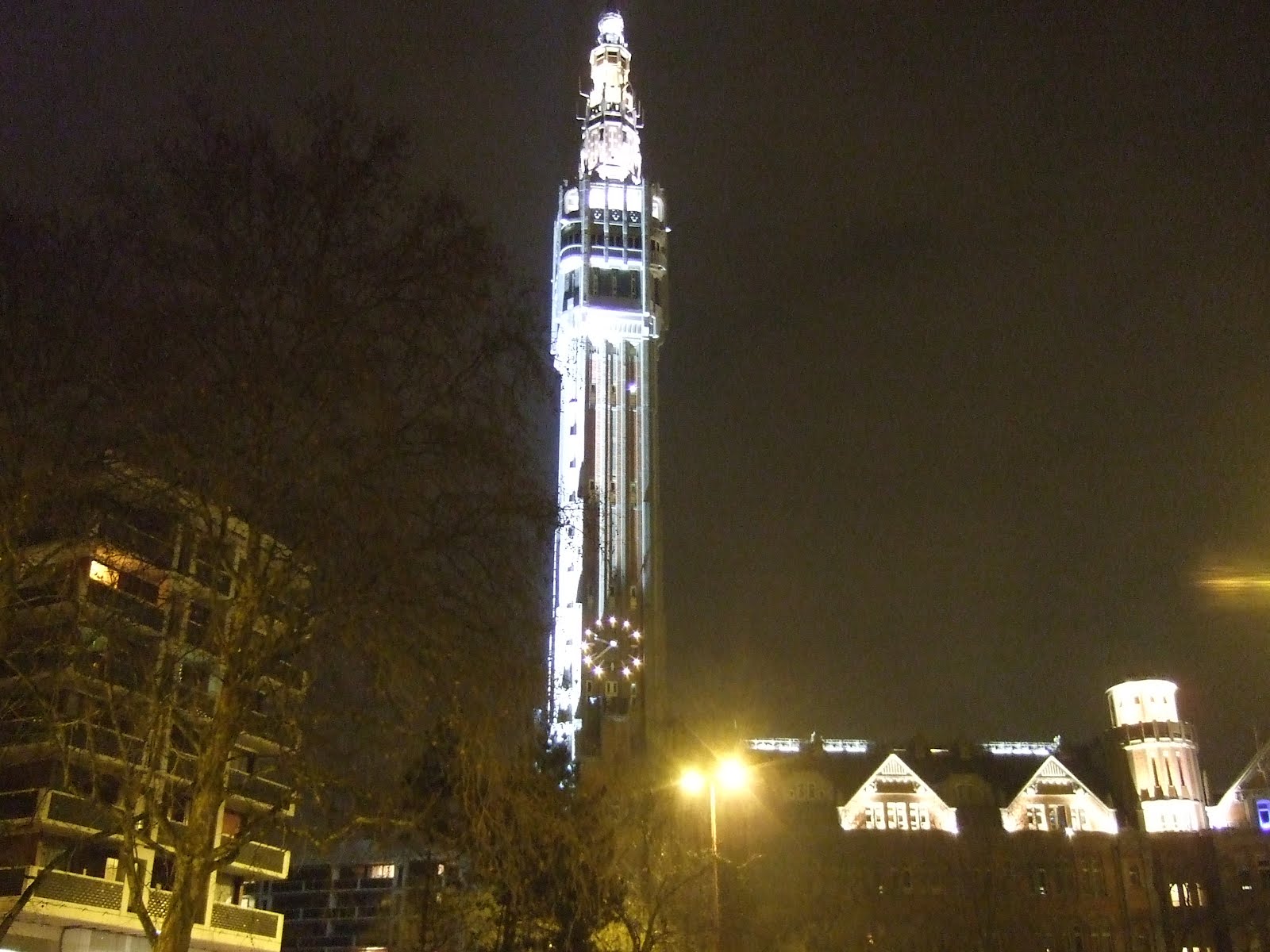
Right opposite the hotel, tucked behind the shabby 1960s shopping centre, we found the town hall with its glorious bell tower. Apparently bell towers are something of a tradition in northern France and are seen as a symbol of independence. Luckily this one was built in the 1920s and had a lift; it was also fabulously lit at night.


Out the front of the town hall is a monument celebrating the opening of the building and featuring fine, upstanding country folk carved in a Soviet-esque style.


More towers in the main square, which is an imposing space surrounded by fine buildings and many bars.


Meert bakery; home of the famous Gaufres (wafers) which are sandwiched together with various flavoured pastes and sold in boxes. The bakery sells a huge array of dainty sandwiches, biscuits and cakes, as well as old-fashioned-looking sweets in a traditional sweet shop next door. There's a tearoom at the back too.


On the same street I found a fabulous craft shop with walls that had shelves from top to bottom with dozens of jars of buttons on one side, and a huge array of yarn skeins on the other; turns out it's a French craft shop chain!


We rounded the weekend off with a trip to the former textile town of Roubaix - accessible by metro - where we paid a visit to the museum which is housed in a former art deco swimming pool. Incredibly beautiful and peaceful, the museum has a permanent collection of sculptures and paintings, including quite a lot of local artists, and also has historical artefacts relating to the textile industry for which Roubaix used to be known.


They have a lot of sample books, some of which are open on display behind glass, the rest you can see by appointment. Many of these samples came from the early part of the 20th century which I was very surprised by, I thought a lot of them looked far too modern!

Wednesday, July 13

Wroclaw cycle culture

The last few weeks have been a whirlwind, mostly of work, but as part of that, it's good to be able to get out of the office and visit other places in Europe from time to time.


This was my first visit to Poland, to the small city of Wroclaw (pronounced Vrot-swarv) and I found it a very welcoming, friendly and interesting city. The market square is very pretty, although most of the buildings are replicas - it was flattened in the second world war and has been rebuilt since then.


Wroclaw has very young population, as the city has two big universities; the area is flat and there are lots of canals and waterways, and cycling is extremely popular with all ages.

There are a lot of cycle paths, but it's also acceptable to cycle on the pavements, and it seems to work very well. On the whole, cyclists go slowly and respect pedestrians, you don't get the feeling that you are putting your life at risk when walking along the pavement.


The city has its own bike rental scheme 'nextbike' a la Boris Bikes, which seems to be pretty new, and the Scandic hotel, where I stayed, had bikes that could be borrowed for free by guests.


They have lots of bike racks for locking up your own bike - including some rather beautiful ones such as these shown here.


Naturally, being Europe, there are also plenty of trams and buses for those preferring to use public transport.

Saturday, June 11

Cathedral of Learning, University of Pittsburgh

My business life involves an annual visit to the Pennsylvanian city of Pittsburgh - famous historically as the centre of the steel industry, and named after the British statesman William Pitt the Elder.


My colleague and I usually plan to arrive on Saturday and have a free day on Sunday, which enables us to do a bit of sightseeing or shopping - whether it's the Warhol Museum, cycling along the riverside bikepaths, or checking out one of the city's ginormous yarn stores.

This year we revisited the amazing Cathedral of Learning, part of the University of Pittsburgh; a late gothic revival building which is a dramatic landmark in the city and houses some fantastic architecture.

The building was commissioned in 1921 and opened in 1937 - its design by architect Charles Klauder was intended to combine the trend for skyscrapers with the ideals of gothic architecture, and its steel framed, stone-clad building achieves this very successfully. There was a lot of resistance to the height of the structure (163m) at the time - unsurprisingly as it is huge and can be seen for miles around.

In the central area of the ground floor is a huge reading room - the Commons Room - which has been called one of the "great architectural fantasies of the twentieth century". It is a fifteenth-century English perpendicular Gothic-style hall that covers 2,000m² and extends over four storeys, to a height of 16m.

Chancellor John Gabbert Bowman, who commissioned the building, wanted to recognise the many nationalities that had contributed to the development of the city, and he did so by commissioning the nationality rooms - a series of 27 classrooms representing those nationalities of which there was a significant population in the city.

Invitations were extended to the nationality communities that made up the Pittsburgh area to provide a room that was representative of their heritage. Each group had to form a Room Committee, which would be responsible for all fundraising, designing, and acquisition. The University provided the room and upkeep in perpetuity once completed, while all other materials, labour, and design were provided by the individual committees.

These rooms are still used as classrooms - afterward, in a bar down the road, we chatted to an undergraduate at the university who had been assigned several of these rooms for lessons during his studies there.

The building is open to visitors, and you can visit the Commons Room and peek into the Syria-Lebanon room anytime, as it has a glass front to it. I think they run tours of the Nationality Rooms but couldn't find any link online. We snuck in for a look and tried the doors of the classrooms, some of which were open, including my favourite, the Hungarian Room.

The wonderful stained glass windows with images of famous Hungarians and scenes from folk tales were a highlight (I recommend you click the pictures to see the full details):


Saturday, September 18

French architecture

The good and the bad.


This is the town clock and the town hall of Desvres in northern France. The town is known for its painted pottery and we had come here for lunch in one of the cafes in the market square. We had not bargained for the godawful architecture. From the look of the town, the same 'architect' was employed to design the clock, the town hall and the library. Perhaps he or she is related to the mayor?

Apparently the clock is designed to reflect the town's famous ceramics - which explains the tiles around its base but doesn't give any clue as to the 'inspiration' behind the remainder of the pile of po-mo poo.


Thankfully my short stay in France included many sights to gladden the eyes, such as the glorious surroundings of the campsite we stayed in at Manoir de Senlecques in Pernes Les Boulogne.

Saturday, June 12

Cycling in Manhattan

I have never really thought of New York as a city for cyclists, but on the latest visit I just couldn't help noticing them everywhere! Cycle racks are prevalent in Manhattan, many streets have them every few yards - not in great swathes but one or two at a time. I guess with the miniscule size of most apartments in Manhattan, many cyclists have to lock their bikes out on the street.


On the subway, bikes are allowed at all times unlike on the London Underground, which only allows folding bikes - although of course the subway is only just below ground level so it's not so difficult to get your bike down there. The suburban trains have similar rush-hour restrictions to those in London.

The main downside for cyclists (apart from motorists!) is that nearly all streets are one-way, which means that you may face a long detour just to get to the next block, if you find yourself wanting to go the wrong way. I guess that's why it's fairly common to see the less sensible cyclists going against the flow of traffic on one-way streets.

I found myself with most of Saturday free, so decided to hire a bike for a few hours and explore the Hudson River Park which is bordered by a traffic-free cycle path all the way down the side of Manhattan Island.


When I set off at about 9am it was nice and quiet, with cyclists and joggers sharing the route without any problem. Scented flowers and shrubs are planted along the borders of the path, making it a very pleasant ride - although the acres of roses planted outside the New York Department of Sanitation building could not totally disguise the smell of rubbish!


The Hudson River Park is delightful, taking in some of the old piers that have been repurposed with seating, lawns and landscaping, as well as offering unobstructed views out to New Jersey on the other side of the river. I followed the path all the way down to Battery Park on the tip of Manhattan, then made my way back, taking a diversion through the meat-packing district and having a look at the start of the High Line - an old railway viaduct which has been redeveloped into an elevated park. Definitely a destination for my next free day in the Big Apple.


North of the bike rental place (at Pier 84, around 45th Street) the bike path runs below the elevated highway, which makes for an even more pleasant ride - shaded from the sun which by now was quite hot, and also suffering much less traffic noise. By this time, however - about midday - the path was becoming quite a cycle superhighway with groups of tourists pedalling gingerly along and being overtaken by aggressive lycra louts. Time to hand the clunky, squeaky bike back and call it a day.

Saturday, March 13

The excitement of business travel


Quite apart from hours of airport queuing and flights full of school parties of Italian teenagers, my recent trip involved the glamour of driving for miles on busy motorways (now have a bad back), bland motels with nothing on the tele but football or Euro-soaps, six visits to factories/offices in ugly suburbs and the prospect of wrestling with exchange rates on the expenses form on my return.

Of course it's not all so glum - I did manage to glimpse the city of Como and a couple of Swiss lakes out of the car window, and I sampled some excellent pizzas. But on the whole I'd rather sleep in my own bed and eat what I have cooked myself.

Here's a few snatches of Euro-soap in case you have forgotten or don't know just how bad they are. Come to that I can't say I'm a fan of English soaps either - unless we are talking about the Archers of course.....!

Anyone suggest any good captions for these?